
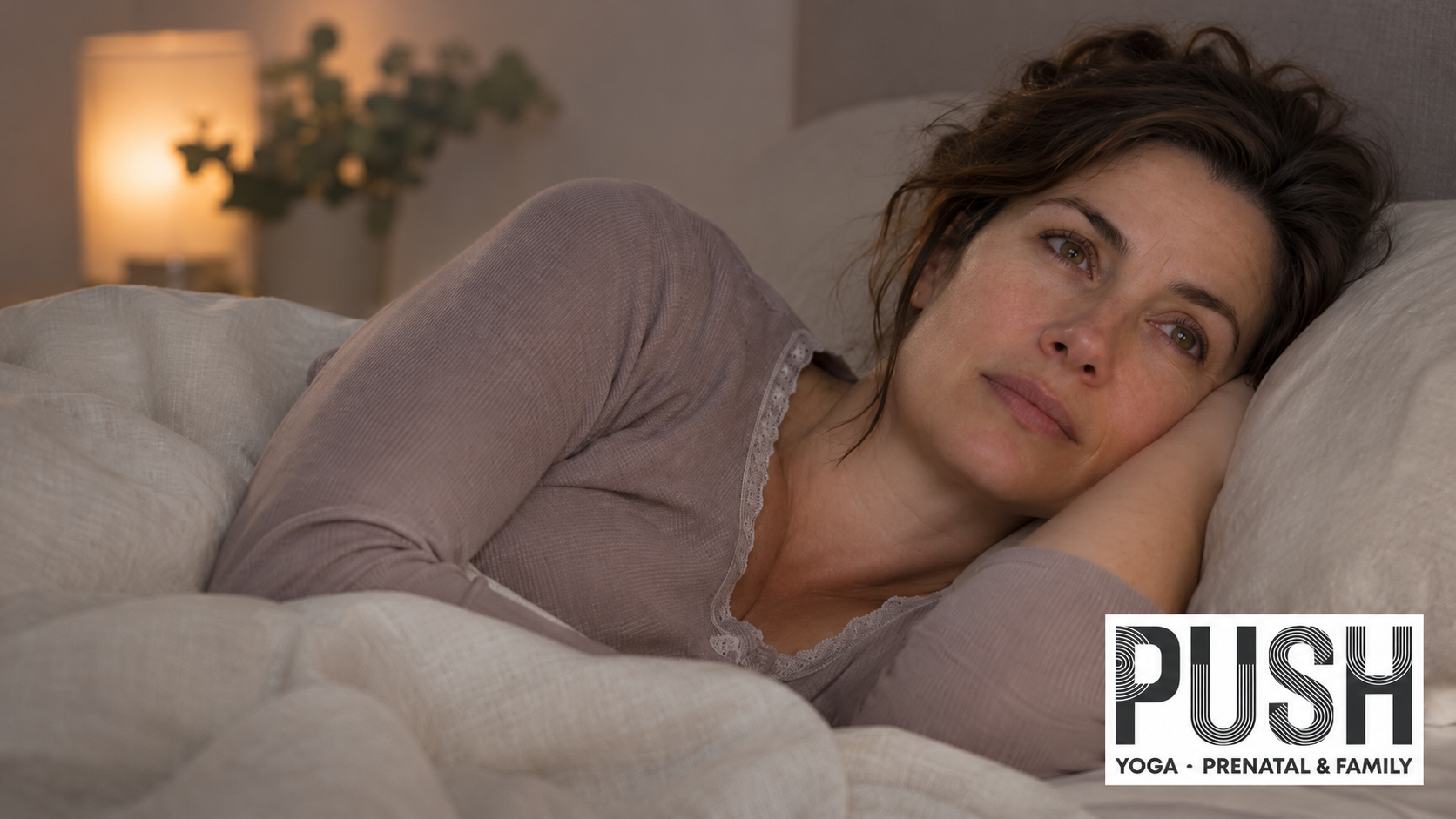
Struggling to fall asleep or waking during the night? Learn how stress, motherhood, perimenopause, pain and lifestyle can affect sleep and when to seek help.
When You’re Tired — But Somehow Still Can’t Sleep
You finally get into bed.
You’re exhausted.
You’ve been thinking about sleep since sometime around 2:00 in the afternoon.
And then your head hits the pillow and suddenly your brain is wide awake.
You replay a conversation from earlier in the day.
Remember something you need to do tomorrow.
Wonder whether you responded to that email.
Think about one of your kids.
Check the time.
And then start calculating how many hours of sleep you’ll get if you fall asleep right now.
Sound familiar?
Sleep can be complicated.
Sometimes the problem is falling asleep. Sometimes you fall asleep easily but wake several times through the night. Maybe you wake at 3:00 a.m. and can’t get back to sleep. Or perhaps you technically sleep for seven or eight hours but still wake feeling exhausted.
There are many reasons sleep can change.
Stress, motherhood, hormones, pain, lifestyle, mental health, and medical conditions can all play a role.
And for many women, several of those things are happening at the same time.
How Much Sleep Do We Actually Need?
Most adults need around seven to nine hours of sleep each night, although individual needs vary.
But sleep isn’t only about the number of hours you spend in bed.
Quality matters too.
You may be in bed for eight hours but spend much of the night waking, tossing and turning, or struggling to fall back asleep.
That’s why it can be useful to think about both sleep quantity and sleep quality.
Signs that your sleep may not be meeting your needs can include:
- Difficulty waking in the morning
- Feeling sleepy during the day
- Needing large amounts of caffeine to function
- Difficulty concentrating
- Irritability
- Low energy
- Falling asleep unintentionally
- Feeling like you could nap every afternoon
- Sleeping longer whenever you get the opportunity
An occasional poor night’s sleep is part of life.
Persistent sleep problems are different.
Why Does Sleep Matter So Much?
Sleep is not simply a period when nothing is happening.
Your body and brain are doing important work while you sleep.
Adequate sleep supports:
- Mood and emotional regulation
- Memory and concentration
- Immune function
- Metabolic health
- Cardiovascular health
- Physical recovery
- Exercise performance
- Appetite regulation
- Overall energy and well-being
This is one reason poor sleep can seem to affect everything.
After several difficult nights, you may notice that you have less patience, more cravings, less motivation to exercise, difficulty concentrating, and a shorter emotional fuse.
Sometimes you don’t feel like yourself simply because you’re exhausted.
Why Can’t I Fall Asleep Even When I’m Tired?
Being tired and being ready to sleep are not always the same thing.
You can be physically exhausted while your nervous system still feels alert.
Your body may be lying in bed while your brain is still managing tomorrow.
Work.
Children.
Finances.
Relationships.
Appointments.
A difficult conversation.
Something you forgot to do.
The mental load of keeping everyday life organized can become particularly noticeable at bedtime because it may be the first quiet moment you’ve had all day.
Suddenly there is nothing distracting you from everything your brain has been holding.
The result can be the frustrating experience of being completely exhausted and completely awake at the same time.
Stress and Sleep Can Create a Cycle
Stress can interfere with sleep.
Then poor sleep can make stress feel harder to manage.
You may become more irritable, anxious, or emotionally reactive.
Small problems feel bigger.
Your ability to concentrate decreases.
Then you start worrying about sleep itself.
What if I can’t sleep again tonight?
That anxiety can make bedtime feel like another performance you have to get right.
Over time, your brain can begin associating bed with worrying about whether you will sleep.
Breaking this cycle sometimes requires more than simply trying harder to relax.
Motherhood Can Completely Change Sleep
Before having children, sleep may have been mostly about your own body.
After children, someone else’s sleep suddenly matters too.
Newborns wake frequently.
Babies go through changing sleep patterns.
Toddlers appear beside your bed at 2:00 a.m.
Older children have nightmares, illnesses, early hockey practices, and mornings when they somehow wake before sunrise.
Even when your children are finally sleeping through the night, your own sleep may not immediately return to normal.
Some mothers become lighter sleepers.
Others find themselves waking automatically even when the baby doesn’t.
And the mental load of parenting can continue long after nighttime feeds are gone.
You may finally have the opportunity to sleep but find that your brain hasn’t received the message.
Postpartum Sleep Is Different
Telling a new parent to “get eight hours of sleep” is not particularly useful advice.
In the early postpartum period, sleep is often fragmented by feeding and caring for a newborn.
That doesn’t mean sleep doesn’t matter.
It means support needs to be realistic.
Sometimes the goal is finding opportunities for rest rather than achieving a perfect nighttime routine.
Sharing nighttime responsibilities where possible, accepting help, protecting opportunities to sleep, and addressing feeding or mental health concerns can all be more useful than trying to follow generic sleep advice designed for someone without a newborn.
Persistent inability to sleep even when your baby is sleeping — particularly when accompanied by significant anxiety, agitation, low mood, racing thoughts, or feeling unlike yourself — deserves attention from a healthcare professional.
Postpartum sleep difficulties are not always just about the baby waking up.
Perimenopause Can Change Sleep Too
For many women, sleep changes become noticeable in their 40s.
You may have slept reasonably well for years and suddenly find yourself waking repeatedly.
Or perhaps you wake at 3:00 or 4:00 a.m. and can’t get back to sleep.
Perimenopause involves fluctuating levels of estrogen and progesterone, and sleep disturbance is common during the menopause transition.
Hot flashes and night sweats can obviously interrupt sleep.
But some women experience sleep problems even when night sweats aren’t the main issue.
Mood changes, anxiety, stress, and other physical symptoms may also contribute.
And unfortunately, poor sleep can make many other perimenopause symptoms feel harder to manage.
Why Do I Keep Waking Up at 3 A.M.?
There is nothing uniquely magical about 3:00 a.m.
But waking during the second half of the night is a common complaint.
Sleep naturally occurs in cycles, and brief awakenings during the night are normal.
The problem is when you become fully awake and can’t return to sleep.
Hormonal changes, stress, anxiety, alcohol, temperature, pain, sleep disorders, environmental disruptions, and simply spending too much time awake in bed can all contribute.
What tends not to help is looking at the clock every few minutes.
Watching the available hours disappear can quickly turn a normal nighttime awakening into an anxiety-provoking event.
Could Anxiety Be Affecting My Sleep?
Absolutely.
Anxiety does not always look like panic attacks.
Sometimes it looks like lying in bed thinking.
You may replay conversations, plan tomorrow, imagine worst-case scenarios, or feel unable to shut your mind down.
You might also experience physical signs such as:
- Muscle tension
- Jaw clenching
- A racing heart
- Restlessness
- Shallow breathing
- Feeling constantly alert
Psychotherapy can help when worry, stress, or persistent thoughts are interfering with sleep.
For chronic insomnia specifically, cognitive behavioural therapy for insomnia — often called CBT-I — is considered a first-line treatment.
CBT-I goes beyond general relaxation advice and focuses specifically on the thoughts, behaviours, and patterns that can perpetuate insomnia.
Pain Can Keep You Awake
Sometimes sleep isn’t primarily a sleep problem.
It’s a pain problem.
Neck pain makes it difficult to find a comfortable position.
Your hip hurts when you lie on your side.
Your back aches.
Your jaw is tense.
Pregnancy makes every sleeping position uncomfortable.
Postpartum feeding positions leave your shoulders sore.
Pain may wake you during the night or prevent you from settling comfortably in the first place.
In those situations, addressing the underlying musculoskeletal issue through physiotherapy, massage therapy, or other appropriate care may indirectly make sleep easier.
The goal isn’t to “treat insomnia” with massage or physiotherapy.
It’s to address the pain that may be getting in the way of comfortable sleep.
What About Exercise?
Regular physical activity can support healthy sleep.
Walking, strength training, cardiovascular exercise, yoga, and other forms of movement can all be part of a healthy routine.
Exercise can also help with stress, physical function, and overall well-being.
But more exercise is not always the answer.
If you’re already exhausted and under-recovered, adding an intense workout every day may leave you feeling worse rather than better.
Think about movement as part of your overall health rather than punishment for sleeping poorly.
Some days that might mean strength training.
Other days it may be a walk or a gentle yoga class.
Consistency matters more than perfection.
Can Massage Help With Sleep?
Many people find massage relaxing.
Massage therapy may help reduce muscle tension and provide an opportunity to slow down, particularly when physical tension or discomfort is making it difficult to settle.
But it is important to keep expectations realistic.
Massage is not a treatment for every cause of insomnia.
If you have persistent sleep problems, the goal should be understanding what is contributing rather than assuming one wellness treatment will solve it.
Massage may be one supportive part of a larger approach.
What About Acupuncture?
Some people seek acupuncture for concerns related to stress, relaxation, pain, or sleep.
Research into acupuncture for insomnia and menopause-related sleep symptoms continues, and individual experiences vary.
If acupuncture is something you’re interested in, it can be considered alongside other evidence-based approaches rather than as a replacement for appropriate medical evaluation or established insomnia treatment.
As with many wellness therapies, it is useful to think of it as one possible piece of the puzzle rather than a guaranteed solution.
Does Your Phone Really Affect Your Sleep?
Potentially — but the answer is more complicated than “screens are bad.”
Bright light in the evening can influence the body’s sleep-wake rhythms, and stimulating content can make it harder to wind down.
But what you’re doing on your phone matters too.
Reading something calm is different from answering work emails, watching emotionally charged videos, or scrolling through social media until midnight.
If your phone is regularly keeping you awake longer than you intended, that is useful information.
You don’t necessarily need a complicated digital detox.
Sometimes the simplest intervention is giving yourself a reasonable stopping point.
Caffeine May Be Lasting Longer Than You Think
Caffeine can stay in the body for hours.
That afternoon coffee may therefore still be affecting you at bedtime, even if you don’t consciously feel stimulated.
People also metabolize caffeine differently.
If you’re struggling with sleep, consider how much caffeine you’re consuming and how late in the day you’re having it.
Coffee isn’t the only source.
Tea, energy drinks, cola, chocolate, pre-workout supplements, and some medications may also contain caffeine.
You don’t necessarily have to give up your morning coffee.
Timing may matter more.
Alcohol Can Make You Sleepy — But Disrupt Sleep Later
Alcohol may make it easier to fall asleep initially.
That can make it feel like it helps with sleep.
But alcohol can disrupt sleep quality later in the night and contribute to nighttime awakenings.
It can also worsen snoring and sleep-disordered breathing in some people.
If you’re regularly waking during the night, consider whether alcohol may be playing a role.
A Better Bedtime Routine Doesn’t Have to Be Complicated
Sleep advice can quickly become another overwhelming list of things you’re supposed to do perfectly.
You don’t need a 12-step evening routine.
Start with the basics.
Try to keep your sleep and wake times reasonably consistent.
Give yourself enough opportunity to sleep.
Keep your room comfortable, dark, and quiet.
Reduce stimulating activities close to bedtime.
Pay attention to caffeine and alcohol.
Move your body regularly.
And create some separation between the demands of the day and getting into bed.
For one person that might mean reading.
For another, a warm shower.
Gentle stretching.
Journaling.
A short breathing exercise.
Or simply putting the phone down.
The routine itself doesn’t need to be impressive.
It just needs to help your body recognize that the day is ending.
What If I’m Awake in Bed and Can’t Sleep?
One of the most frustrating things about insomnia is trying to force sleep.
Unfortunately, sleep doesn’t respond very well to force.
If you spend long periods lying awake and becoming increasingly frustrated, getting out of bed briefly and doing something quiet in dim light can sometimes be more helpful than remaining there watching the clock.
Return to bed when you feel sleepy again.
This is one of the principles used in behavioural treatment for insomnia.
The goal is to strengthen the connection between bed and sleep rather than bed and worrying.
When Is Poor Sleep More Than Just Stress?
Persistent sleep problems deserve attention.
Speak with a healthcare professional if you regularly have difficulty falling asleep, staying asleep, or waking too early and it is affecting your daytime functioning.
You should also seek assessment if you experience:
- Loud or disruptive snoring
- Gasping or choking during sleep
- Witnessed pauses in breathing
- Significant daytime sleepiness
- Falling asleep while driving or during other activities
- Persistent restless or uncomfortable legs at night
- Frequent morning headaches
- Sleep problems associated with significant anxiety or depression
- Major changes in sleep without an obvious explanation
Not every sleep problem should be blamed on stress, motherhood, or hormones.
Frequently Asked Questions About Sleep
Why am I exhausted but can’t sleep?
Stress, anxiety, hormonal changes, pain, caffeine, sleep habits, medical conditions, and sleep disorders can all contribute.
Sometimes several factors are present at once.
If the problem persists, an assessment can help determine what may be driving it.
Is waking up during the night normal?
Brief nighttime awakenings are normal.
The concern is when you are waking frequently, remaining awake for long periods, or feeling significantly tired during the day.
Can perimenopause cause insomnia?
Sleep disturbance is common during perimenopause.
Night sweats can contribute, but hormonal changes, mood symptoms, anxiety, and other factors may also affect sleep.
Why has my sleep become worse in my 40s?
There may not be one cause.
Perimenopause, stress, parenting responsibilities, work demands, pain, lifestyle changes, and sleep disorders can all become relevant during this stage of life.
It is worth looking at the full picture rather than assuming poor sleep is simply part of getting older.
Can exercise improve sleep?
Regular physical activity can support sleep and overall health.
The ideal amount and timing will vary, and exercise is not a standalone treatment for every sleep disorder.
Can therapy help with insomnia?
Yes.
If stress, anxiety, or persistent thoughts are affecting sleep, psychotherapy may help address those concerns.
For chronic insomnia, CBT-I is a specific evidence-based treatment and is generally considered a first-line approach.
Should I take melatonin?
Melatonin can be useful in particular circumstances, but it isn’t the answer to every sleep problem.
The appropriate dose and timing depend on why it is being used.
If sleep problems are persistent, speak with your healthcare provider or pharmacist rather than simply increasing the dose on your own.
When should I see someone about my sleep?
Consider speaking with a healthcare professional if poor sleep persists, affects your daytime functioning, or is accompanied by symptoms such as significant daytime sleepiness, snoring, gasping, restless legs, mood changes, or other health concerns.
Sleep Doesn’t Have to Become Another Thing You’re Failing At
When you’re already tired, being told you need to “prioritize sleep” can feel almost insulting.
Most people with sleep difficulties already want to sleep.
The issue is figuring out what is getting in the way.
Maybe it’s a baby.
Maybe it’s stress.
Maybe it’s perimenopause.
Maybe it’s pain.
Maybe it’s anxiety.
Maybe several things are happening at once.
At PUSH Markham, we believe wellness is connected.
Sleep can be influenced by your mental health, physical comfort, movement, hormones, stage of life, and what your days actually look like.
Depending on what is contributing, support might include psychotherapy, massage therapy, physiotherapy, acupuncture, movement, or a conversation with your primary healthcare provider.
You don’t need to create the perfect bedtime routine.
Start by understanding why sleep has become difficult.
From there, you can figure out what kind of support actually makes sense.
Tired of feeling tired?
Explore the wellness and mental health services at PUSH Markham and find support that fits what your body — and your life — need right now.