Discover why strength training is important for women over 40, including benefits for muscle, bone health, perimenopause, metabolism and healthy aging.
Building Strength for the Life You Want to Keep Living
For many women, exercise has traditionally meant cardio.
Walking. Running. Cycling. Fitness classes. Maybe yoga or Pilates.
Strength training can feel like something different — something for athletes, people who already know their way around a gym, or people who want to build big muscles.
But as we move through our 40s and beyond, strength training becomes increasingly important for reasons that have very little to do with looking a certain way.
Muscle mass, bone health, balance, metabolism, joint health, and our ability to comfortably do the things we enjoy can all change as we age.
Strength training gives us a way to actively support those things.
And you don’t need to be strong before you start.
Whether you have never picked up a dumbbell, are returning to exercise after years away, or already exercise regularly but have never made resistance training a priority, your 40s are a great time to start building strength.
What Happens to Muscle as We Get Older?
Our bodies naturally change with age.
Beginning in adulthood, muscle mass and strength can gradually decline, particularly if we are not regularly challenging our muscles.
For women, the hormonal changes that occur during perimenopause and menopause can add another layer to these changes.
You may notice that activities that once felt easy require a little more effort. Recovery can feel different. Body composition may change. Or you may simply realize that the exercise routine that worked for you at 30 doesn’t seem to be doing quite the same thing at 45.
This doesn’t mean decline is inevitable.
Muscle responds to challenge at many ages.
Resistance training provides that challenge, encouraging your muscles to adapt and become stronger.
That makes strength training one of the most useful forms of exercise to carry with you through midlife and beyond.
What Counts as Strength Training?
Strength training — also called resistance training — simply means asking your muscles to work against resistance.
That resistance can come from:
- Dumbbells
- Barbells
- Kettlebells
- Resistance bands
- Weight machines
- Cable machines
- Your own body weight
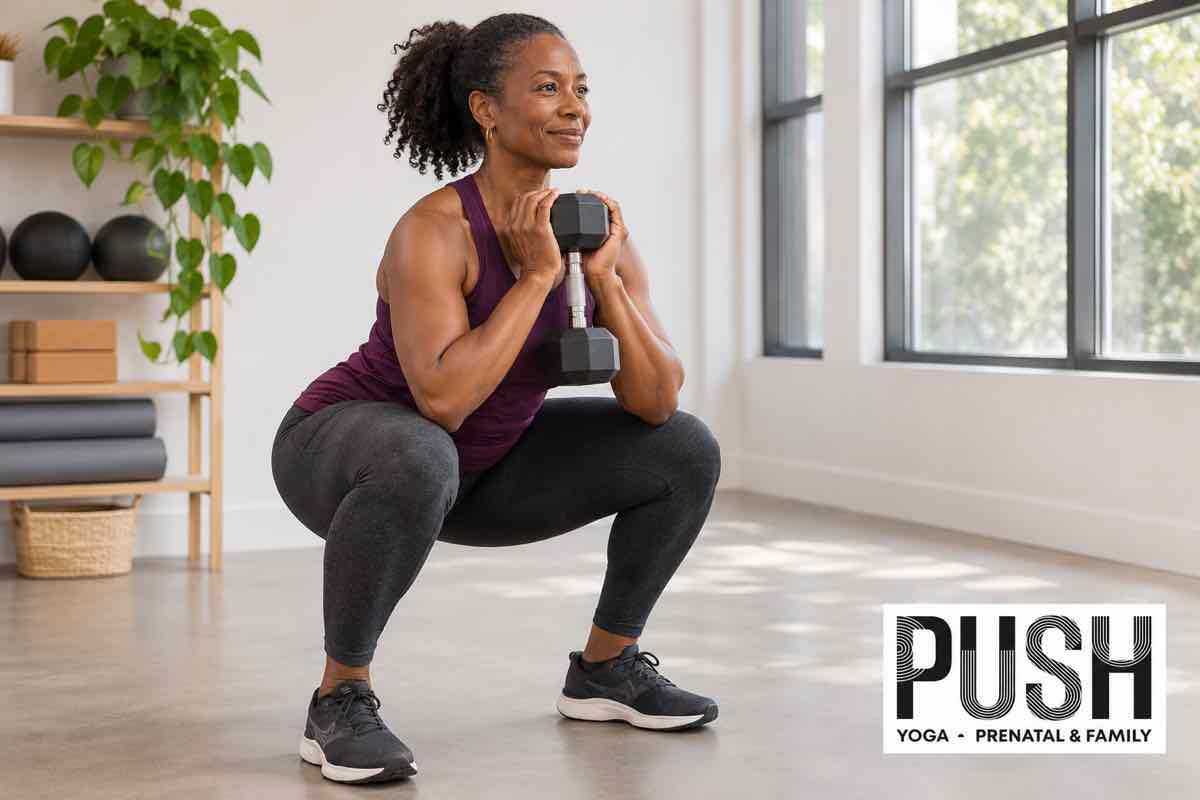
Exercises might include squats, lunges, rows, presses, hinges, carries, step-ups, and other movements that challenge different muscle groups.
You don’t need a complicated routine.
A handful of well-chosen exercises that work the major areas of the body can provide an excellent foundation.
And despite what social media sometimes suggests, you do not need an elaborate collection of exercises or a new workout every week.
Often, getting comfortable with a few foundational movements and gradually progressing them is more useful.
Why Strength Training Matters After 40
There are many reasons to build and maintain strength as we age.
Some are visible. Many are not.
That might mean carrying groceries without thinking twice about it.
Lifting a suitcase into an overhead compartment.
Getting up from the floor easily.
Gardening.
Playing with your children.
Hiking on vacation.
Carrying laundry up the stairs.
Or continuing to participate in the sports and activities you enjoy.
Strength isn’t only something you build in the gym.
It is something you use in everyday life.
Strength Training and Perimenopause
For many women, their 40s also overlap with the beginning of perimenopause.
During the menopause transition, estrogen and progesterone begin to fluctuate. Changes in sleep, energy, body composition, mood, muscle, and bone health may occur alongside these hormonal shifts.
This can make exercise feel different.
You may find that recovery takes a little longer or that a routine focused mainly on cardio no longer feels like enough.
Strength training can become particularly valuable during this stage because it directly challenges muscles and bones.
It won’t eliminate every symptom of perimenopause, and exercise shouldn’t be presented as a cure for hormonal changes.
But building and maintaining strength can be an important part of supporting your body through this transition and into the years that follow.
Strength Training Supports Bone Health
Our bones are living tissue.
Like muscles, they respond to the demands we place on them.
Bone density naturally changes with age, and the decline in estrogen associated with menopause can accelerate bone loss.
This makes bone health increasingly important for women in midlife.
Resistance training and appropriate weight-bearing exercise place mechanical stress on the body, which can help support bone strength.
Walking is beneficial for many aspects of health, but adding resistance training provides a different type of stimulus.
This is one reason a well-rounded movement routine becomes so valuable as we get older.
What About Metabolism and Weight Changes?
Many women notice changes in body composition during their 40s.
Maybe your clothes fit differently even though the scale hasn’t changed much. Perhaps weight seems easier to gain or harder to lose. Or you notice more weight settling around your abdomen.
Hormones can play a role, but they are not the only factor.
Aging, sleep, stress, nutrition, activity levels, genetics, and changes in muscle mass can all contribute.
Strength training can help preserve or build lean muscle tissue, which supports metabolic health and physical function.
But it can also offer something valuable beyond the number on the scale.
Instead of exercise being entirely about burning calories or making your body smaller, strength training gives you another way to measure progress.
The weight that once felt heavy becomes manageable.
You can do an exercise you couldn’t do before.
You carry something without asking for help.
You feel steadier, stronger, and more capable.
Those changes matter too.
Will Strength Training Make Me Bulky?
This is still one of the most common concerns women have about lifting weights.
For most women, accidentally becoming excessively muscular from a few strength-training sessions each week is not a realistic concern.
Building substantial muscle requires significant training volume, progressive overload, nutrition, genetics, and time.
Resistance training may change body composition and build muscle, but the process is gradual.
More importantly, muscle is exactly what we are trying to preserve as we age.
Rather than asking whether strength training will make you “bulky,” it may be more helpful to ask:
What do I want my body to still be able to do 10, 20, or 30 years from now?
Strength training helps you work toward that answer.
Is Walking Enough?
Walking is excellent exercise.
If you walk regularly, keep doing it.
Walking supports cardiovascular health, mood, mobility, and overall physical activity. It is accessible and easy to incorporate into everyday life.
But walking and strength training do different things.
Walking generally does not provide enough resistance to challenge all of your major muscle groups in the same way that progressive strength training does.
You don’t need to replace your walks.
Instead, think about adding strength training alongside them.
A routine that includes regular walking, strength work, and other movement you enjoy can be more balanced than relying on one form of exercise alone.
What About Yoga and Pilates?
Yoga and Pilates can absolutely remain part of your routine.
Both can support mobility, balance, coordination, body awareness, and strength depending on how they are practised.
But if your goal is to progressively increase muscular strength, it can be useful to include exercises where resistance can gradually increase over time.
That may mean using heavier dumbbells, increasing resistance, progressing an exercise, or changing the number of repetitions or sets.
You don’t have to choose between yoga, Pilates, walking, cardio, and weights.
Different forms of movement can support different aspects of your health.
The goal is to build a routine that works together.
“But I’ve Never Lifted Weights Before”
You are not behind.
Many women begin strength training in their 40s, 50s, 60s, and beyond.
The hardest part is often not the physical exercise. It is feeling comfortable enough to begin.
Gym environments can feel intimidating when you don’t know what the equipment does, how heavy your weights should be, or whether you’re performing an exercise correctly.
You may look around and assume everyone else knows exactly what they are doing.
They probably didn’t when they started either.
You don’t need to learn everything at once.
Start with a few foundational movements. Learn what good technique feels like. Choose resistance that is challenging but manageable. Give yourself time to become comfortable.
Confidence tends to grow alongside strength.
How Heavy Should Women Over 40 Lift?
There is no single correct weight.
The appropriate resistance depends on the exercise, your current strength, your experience, injuries or health conditions, and your goals.
A weight should generally feel challenging enough that your muscles are working, while still allowing you to perform the movement with good control and technique.
As you become stronger, the same weight will eventually feel easier.
That is when it may be appropriate to gradually increase the challenge.
This concept is called progressive overload.
It doesn’t mean adding weight every workout.
Progress might mean lifting slightly more weight, doing another repetition, improving your technique, using a greater range of motion, or progressing to a more challenging variation.
Small changes add up.
How Often Should Women Strength Train?
You do not need to lift weights every day.
For many beginners, two strength-training sessions per week can provide a realistic and useful starting point.
As you become more experienced, your routine may change depending on your goals and schedule.
What matters most is consistency.
Two sessions you can realistically maintain are more valuable than an ambitious five-day program that lasts three weeks.
Your routine also needs room for the rest of your life.
Work, children, caregiving, sleep, stress, and other forms of movement all matter when deciding what is sustainable.
Recovery Is Part of Getting Stronger
More is not always better.
Exercise challenges your muscles. Recovery gives them time to adapt.
Sleep, nutrition, hydration, stress management, and rest between challenging workouts all influence recovery.
This can become particularly noticeable during perimenopause, when sleep disruption or hormonal changes may affect how rested you feel.
Some days you may feel ready to push.
Other days you may need to modify your workout, use lighter resistance, or choose gentler movement.
That doesn’t mean you’ve lost progress.
A sustainable strength routine has room for both challenge and recovery.
What If I Have Knee, Back, Shoulder, or Joint Pain?
Having pain does not necessarily mean strength training is off limits.
In fact, appropriately prescribed strengthening exercises are commonly used as part of rehabilitation for many musculoskeletal conditions.
The important part is understanding what is causing your symptoms and choosing exercises and resistance that are appropriate for you.
If pain is persistent, worsening, or limiting your activity, a physiotherapist can assess your movement, strength, mobility, and symptoms and help determine a suitable approach.
The goal should not be to simply “push through” pain.
It should be to find ways to keep moving while addressing what is getting in your way.
Your Pelvic Floor Is Part of Strength Training Too
Some women notice urinary leakage, pelvic pressure, heaviness, or other pelvic floor symptoms when they begin lifting heavier weights.
That can make strength training feel worrying or embarrassing.
These symptoms are common, but they are worth addressing.
Lifting involves coordination between your breathing, abdominal muscles, pelvic floor, and the rest of your body.
A pelvic floor physiotherapist can help assess how these systems are working together and whether modifications or specific rehabilitation may help.
Having pelvic floor symptoms does not automatically mean you should avoid lifting weights.
It may simply mean your body needs some additional support.
What Does a Beginner Strength Workout Look Like?
A beginner program does not need to be complicated.
It might include movements such as:
- A squat or sit-to-stand
- A hip hinge or deadlift variation
- A row or pulling exercise
- A press or pushing exercise
- A step-up or lunge variation
- A carrying exercise
- Core and trunk-strengthening work
The exact exercises will depend on your abilities, goals, equipment, and any injuries or health concerns.
A full-body session can also be relatively short.
You do not need to spend hours in the gym for strength training to be worthwhile.
Building Strength Without Making Fitness Your Whole Life
For many women over 40, the challenge isn’t understanding that exercise is good for you.
It’s finding a way to fit it into an already full life.
This is where simplicity helps.
You might strength train twice a week, walk regularly, and attend a yoga or Pilates class you enjoy.
Someone else might lift three times per week and play a recreational sport.
Another person may begin with short home workouts using dumbbells.
There is no prize for having the most complicated routine.
The goal is to find something you can continue doing.
Frequently Asked Questions About Strength Training for Women Over 40
Is 40 too late to start strength training?
No.
Women can begin resistance training well beyond their 40s and still improve strength and physical function.
Starting gradually and choosing exercises appropriate for your current abilities is more important than the age at which you begin.
How many times a week should a woman over 40 lift weights?
For someone new to strength training, two full-body sessions per week can be a reasonable starting point.
Your ideal schedule will depend on your goals, experience, other activities, and ability to recover.
Do I need a gym to strength train?
No.
Dumbbells, resistance bands, bodyweight exercises, and other simple equipment can all be used for strength training.
A gym can provide more options for gradually increasing resistance, but it isn’t required to begin.
Should I lift heavy weights during perimenopause?
“Heavy” is relative to the person.
The goal is to use enough resistance to challenge your muscles while maintaining good technique and progressing appropriately.
Women do not need to restrict themselves to very light weights simply because they are in perimenopause.
If you are new to lifting or have medical, musculoskeletal, or pelvic health concerns, individualized guidance can help you determine an appropriate starting point.
Is strength training better than cardio after 40?
You don’t have to choose.
Strength training and cardiovascular exercise provide different benefits, and both can be part of a balanced routine.
If your exercise has historically consisted almost entirely of cardio, however, adding resistance training may address areas such as muscle and bone health that cardio alone does not fully target.
Can I strength train if I have osteoporosis?
Resistance exercise can be important for people with low bone density, but the type of exercise and appropriate loading may need to be individualized.
If you have osteoporosis, previous fractures, or significant risk factors, speak with your healthcare provider or physiotherapist about an exercise program appropriate for you.
How long until I notice a difference?
Everyone responds differently.
You may notice improvements in confidence, technique, or how exercises feel before you notice visible changes in your body.
Strength develops gradually.
Rather than focusing on a deadline, look for small signs of progress: using a heavier weight, completing an extra repetition, moving with better control, or noticing that everyday tasks feel easier.
Strong for What Comes Next
Strength training after 40 isn’t about trying to train like you did at 20.
It’s about investing in what you want your body to be able to do next.
Carry the groceries.
Travel.
Keep up with your kids.
Try a new sport.
Get up from the floor.
Protect your bones.
Stay independent.
And feel confident using your body.
You don’t have to become a “gym person” to become stronger.
At PUSH Markham, we believe strength and movement should feel accessible, supportive, and appropriate for your body and stage of life.
Whether you are picking up weights for the first time, returning after a long break, navigating perimenopause, working around an injury, or simply ready to feel stronger, there are many ways to begin.
You just have to start where you are.
Ready to feel more confident with strength training?
Explore strength and movement support at PUSH Markham and find an approach that works for your body, your goals, and your life.